

This work was made possible by grants from the National Science Foundation (NSF 2106206, 2045392, and 1828347). Any opinions, findings, and conclusions or recommendations expressed in the material are those of the authors and do not necessarily reflect the views of the National Science Foundation.
Facilitators
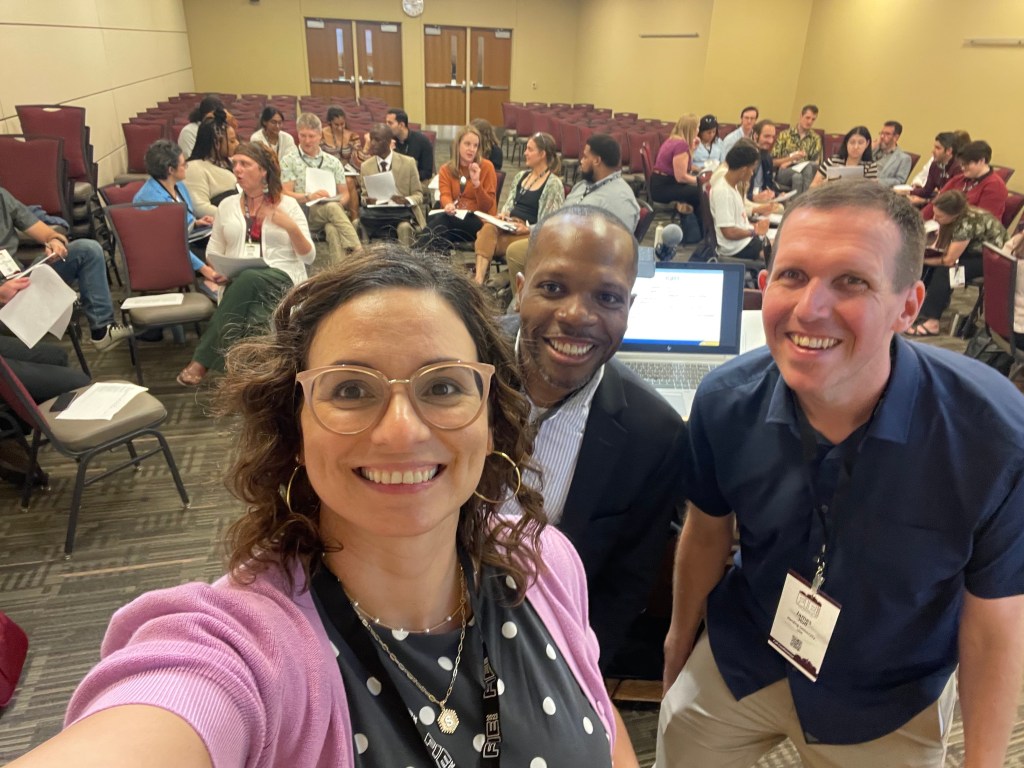
Sindia M. Rivera-Jiménez, Ph.D., University of Florida (Research Website)
Jerrod A. Henderson, Ph.D., University of Florida (Research Website)
James Huff, Ph.D., Harding University (Research Website)
This workshop has been offered:
- October 19, 2023 at Frontiers in Education Conference
- June 25, 2023 at ASEE National Conference
For questions or comments: rivera.jimenez@eng.ufl.edu
Workshop Goals
Workshop objectives:
- Guide participants on skillfully adapting from established interview protocols.
- Introduce participants to mindfulness in creating accessible environments for conducting high-quality data collection.
- Build reflective skills in critically examining the performance of the researcher in conducting a semi-structured interview.
Workshop Resources
Complete Feedback Form for FIE 2023: https://bit.ly/fie23-ssf
Download the IQR Tool: Huff, J. L., & Brooks. A. (2023). Interview Quality Reflection Tool. Open Science Framework. https://osf.io/cavf9
Download the most recent copy of slides used:
Resources
- Esposito, J., & Evans-Winters, V. (2021). Introduction to intersectional qualitative research. SAGE Publications, Incorporated.
- Henderson, J. A., Junqueira, W., Benjamin, L. S. S., Hines, E. M., Alarcón, J. D., Davis, J. L., & Cavazos, S. (2023). Circle of success—An interpretative phenomenological analysis of how Black engineering students experience success. Journal of Engineering Education.
- Huff, J. L., Okai, B., Shanachilubwa, K., Sochacka, N. W., & Walther, J. (2021). Unpacking professional shame: Patterns of White male engineering students living in and out of threats to their identities. Journal of Engineering Education, 110(2), 414-436.
- Boklage, A., Coley, B., & Kellam, N. (2019). Understanding engineering educators’ pedagogical transformations through the Hero’s Journey. European Journal of Engineering Education, 44(6), 923-938.
- Gelles, L., Villanueva, I., & Di Stefano, M. (2019). “Mentoring is ethical, right?”: Women graduate students & faculty in science & engineering speak out. International journal of gender, science and technology, 11(1).
- London, J. S., Lee, W. C., Watford, B. A., Ash, C. H., Holloman, T., Pee, C. M., & Hampton, C. (2022). Climbing Uphill: Toward a Common Agenda for the Advancement of Black Americans in Engineering. Journal of Women and Minorities in Science and Engineering, 28(3).
- Rodriguez, S., Cunningham, K., & Jordan, A. (2019). STEM identity development for Latinas: The role of self-and outside recognition. Journal of Hispanic Higher Education, 18(3), 254-272.
- Huff, J. L., Smith, J. A., Jesiek, B. K., Zoltowski, C. B., Graziano, W. G., & Oakes, W. C. (2014, October). From methods to methodology: Reflection on keeping the philosophical commitments of interpretative phenomenological analysis. In 2014 IEEE Frontiers in Education Conference (FIE) Proceedings (pp. 1-9). IEEE.
- Huff, J. L., Walther, J., Sochacka, N. W., Sharbine, M. B., & Kamanda, H. (2021). Coupling methodological commitments to make sense of socio-psychological experience. Studies in Engineering Education, 1(2).
- Mann, S., & Mann, S. (2016). Research interviews: Modes and types. The Research Interview: Reflective Practice and Reflexivity in Research Processes, 86-113.
- A.Brooks and J. Huff, “Evaluating the quality of interviews with a process-based, self-reflective tool,” presented at the American Society for Engineering Education Conference, Baltimore, MD, USA, Jun. 2023. [Online]. Available: (In Press)
- Weiss, R. S. (1995). Learning from strangers: The art and method of qualitative interview studies. Simon and Schuster.
- Jacob, S. A., & Furgerson, S. P. (2012). Writing interview protocols and conducting interviews: Tips for students new to the field of qualitative research. Qualitative Report, 17, 6.
- Castillo-Montoya, M. (2016). Preparing for interview research: The interview protocol refinement framework. The qualitative report, 21(5), 811-831.
- Schober, M. F. (2018). The future of face-to-face interviewing. Quality Assurance in Education, 26(2), 290-302.
- Carr, E. C., & Worth, A. (2001). The use of the telephone interview for research. NT research, 6(1), 511-524.
- Janghorban, R., Roudsari, R. L., & Taghipour, A. (2014). Skype interviewing: The new generation of online synchronous interview in qualitative research. International journal of qualitative studies on health and well-being, 9(1), 24152.
- Opdenakker, R. (2006, September). Advantages and disadvantages of four interview techniques in qualitative research. In Forum qualitative sozialforschung/forum: Qualitative social research (Vol. 7, No. 4).
- Ratislavová, K., & Ratislav, J. (2014). Asynchronous email interview as a qualitative research method in the humanities. Human Affairs, 24(4), 452-460.
- Lukacik, E. R., Bourdage, J. S., & Roulin, N. (2022). Into the void: A conceptual model and research agenda for the design and use of asynchronous video interviews. Human Resource Management Review, 32(1), 100789.
- Secules, S., Sochacka, N. W., Huff, J. L., & Walther, J. (2021). The social construction of professional shame for undergraduate engineering students. Journal of Engineering Education, 110(4), 861-884.
- Walther, J., Kellam, N., Sochacka, N., & Radcliffe, D. (2011). Engineering competence? An interpretive investigation of engineering students’ professional formation. Journal of Engineering Education, 100(4), 703-740.f
- Leydens, J. A., Moskal, B. M., & Pavelich, M. J. (2004). Qualitative methods used in the assessment of engineering education. Journal of engineering education, 93(1), 65-72.
- Mann, S., & Mann, S. (2016). Research interviews: Modes and types. The Research Interview: Reflective Practice and Reflexivity in Research Processes, 86-113.
 theengineeringprofessor.org